.svg)


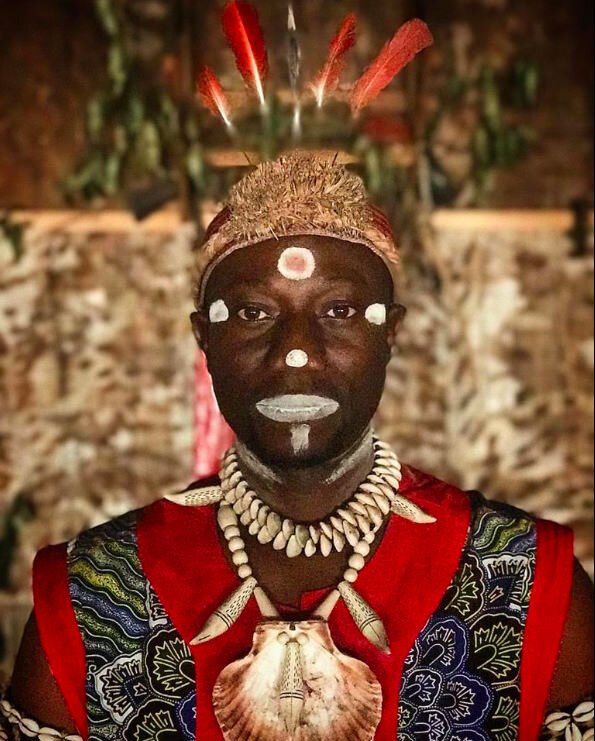
When people ask Moughenda Mikala what Bwiti is, he gives the same answer every time: *"Bwiti is not a religion. It is a school of life."*
This distinction matters more than it might seem. A religion asks you to believe. A school of life asks you to practice, to observe, to test and to discover through direct experience what is true.
The Bwiti Missoko tradition, rooted for thousands of years in the forests of Gabon, has developed one of the most sophisticated and precise understandings of human nature, suffering, and transformation that exists anywhere on earth. Not through philosophy, but through direct encounter between the initiate, the sacred Iboga plant, and the teachers who have held this tradition through countless generations.
This article presents seven of the core teachings of Bwiti not as doctrine, but as living principles that participants in Moughenda's retreats and training programs consistently describe as the most transformative insights they have ever encountered.
##Teaching 1: You Are Already Whole
The foundational premise of Bwiti is radically different from most healing systems: you are not broken. You do not need to be fixed. You are already whole and always have been.
What you are experiencing as brokenness, confusion, or suffering is not the truth of what you are. It is the result of layers trauma, conditioning, fear, ego that have accumulated over the course of your life and obscured the original wholeness underneath.
This is not a comforting philosophy. It is a precise diagnostic. And it completely reframes the purpose of healing: healing is not adding something you lack. Healing is removing what does not belong. The Iboga plant, in the Bwiti tradition, is the supreme tool for this removal not because it adds wisdom, but because it dissolves the layers that were hiding it.
For many people, this teaching lands with a force that years of therapy could not provide: the relief of learning that there is nothing fundamentally wrong with them.
## Teaching 2: Truth Is Medicine
In the Bwiti tradition, truth and medicine are not separate concepts. Iboga is described as *the plant of truth* not metaphorically, but literally. It reveals what is true: about your past, your patterns, your relationships, your purpose.
But more broadly, Bwiti teaches that truth itself radical, unflinching honesty with oneself and others is one of the most healing forces available to a human being.
Lies, even small ones, even the self-protective lies most of us tell ourselves, create a form of fragmentation. The part of you that knows the truth and the part of you that is saying something else must be kept separate through constant effort. This separation is exhausting, and it creates the chronic low-level anxiety that many people accept as simply the texture of life.
The Bwiti practice of truth-telling is one of the most challenging things about living according to Bwiti principles. And consistently, it is what participants describe as producing the most immediate relief.
## Teaching 3: Your Body Is Your Teacher
The mind in Western culture has been elevated at the expense of the body. We trust our thoughts over our sensations, our plans over our instincts, our analysis over our gut feeling.
The Bwiti regard this as one of the most serious errors in Western consciousness and one of the primary sources of the suffering they see in the people who come to them from Europe and North America.
The body, in Bwiti understanding, holds a form of intelligence that the mind cannot access directly. It carries the record of everything you have experienced including what you have never consciously processed. It knows what is true and what is not. It registers the lie before the mind can rationalize it. It signals the right direction before the intellect can justify it.
Iboga's intensely somatic quality the way it roots awareness deep into the physical body during a ceremony is, in Bwiti understanding, part of its healing mechanism. It restores the connection to the body's intelligence that modern life has attenuated.
One of the most common realizations participants describe after a Bwiti ceremony is discovering how long they had been ignoring what their body was clearly telling them about a relationship, a career, a pattern of behavior.
## Teaching 4: The Ancestors Are Alive in You
For people raised in secular Western culture, the concept of ancestor connection can seem abstract or esoteric. In the Bwiti tradition, it is understood with great precision: you carry in your body, your nervous system, and your unconscious mind the unresolved experiences of your lineage.
This is not mysticism it aligns closely with what epigenetics and intergenerational trauma research now confirms. The fear, grief, shame, or disconnection that characterized your parents or grandparents can be transmitted biologically, shaping your emotional responses in ways that have nothing to do with your own lived experience.
Bwiti ceremonies particularly those involving Iboga often produce what participants describe as encounters with ancestral material: visions, voices, or emotional states that clearly belong to a generation before them. The Bwiti regard this not as hallucination, but as the healing process encountering the layer of healing that is ready.
The teaching is not that you are a victim of your ancestors. It is that you can complete what they could not complete and in doing so, free not only yourself but potentially the generations that come after you.
## Teaching 5: Balance Is the Goal Not Transcendence
Many spiritual traditions orient toward transcendence: getting beyond the human condition, the body, the material world. The Bwiti path is different in a way that consistently surprises Westerners.
Bwiti does not teach you to transcend life. It teaches you to inhabit it more fully. The goal is not to escape the human condition it is to live it with full presence, clear sight, and balanced energy.
This balance is described in Bwiti cosmology as the integration of the masculine and feminine principles what they describe as present in Iboga itself, which is understood to carry both a male and female spirit. Balance between action and receptivity. Between thinking and feeling. Between individual expression and relational connection.
This orientation produces something the purely transcendence-oriented paths often struggle to deliver: people who can actually live better in the ordinary world. Who can sustain a business, a relationship, a family with greater ease and clarity. The Bwiti initiation is not an escape from your life. It is a preparation for it.
## Teaching 6: Life Has a Direction Find Yours and Follow It
One of the most frequently reported outcomes of Bwiti ceremonies is a sudden, unexpected clarity about life direction. Not just general inspiration, but specific: a clear sense of what needs to end, what needs to begin, and what the next honest step actually is.
Bwiti teaching holds that every person is born with a specific purpose something that only they can bring to the world in their particular way. Iboga's role in ceremonies is partly to make contact with that original direction to show you what was written in you before the world wrote its own story over the top.
This is not destiny in the sense of being fixed or determined. It is more like a compass pointing toward the direction that is most aligned with your true nature. Following it requires courage, honesty, and often the willingness to disappoint people. But failing to follow it, the Bwiti hold, is the source of the deep dissatisfaction that no amount of external success can resolve.
## Teaching 7: Healing Is Continuous Not an Event
Perhaps the most sobering and most liberating Bwiti teaching is this: there is no single ceremony, no single moment, after which you are "healed" and no further work is required.
Healing, in the Bwiti tradition, is a continuous practice. Life brings new challenges, new layers, new opportunities for deepening. Iboga is a powerful accelerant it compresses years of work into hours but it is not a shortcut around the practice of living with greater awareness.
What the Bwiti offer, and what distinguishes Bwiti House's approach from ibogaine clinics, is exactly this: not just a ceremony, but an initiation into a way of living. The teachings, the practices, the tools of the tradition these are what sustain the transformation that the ceremony initiates.
This is why Bwiti House's global network of providers exists in 22 locations worldwide. Because the ceremony happens in Gabon, but the practice of Bwiti happens everywhere you are.
## The Bwiti School of Life An Ongoing Education
Moughenda Mikala has been teaching these principles since 1990. In that time, he has guided thousands of people from over 40 countries through Iboga ceremonies and trained 50 certified providers who carry this tradition into communities around the world.
What he consistently observes is that the people who receive the most from their time in Gabon are those who approach it not as a treatment, but as an education who arrive asking not "what can this fix?" but "what can I learn?"
The Bwiti school of life has been in session for thousands of years. The doors are open.