.svg)


Iboga and psilocybin are both powerful psychedelics used for healing and self-discovery — but they are profoundly different medicines. Iboga (and its main alkaloid, ibogaine) produces a long, introspective, dream-like life review and is uniquely associated with interrupting addiction, while psilocybin — the compound in ‘magic mushrooms’ — produces a shorter, more visual and emotional journey. This guide compares iboga vs psilocybin across origin, experience, duration, mechanism, safety and tradition.
If you are weighing these two paths, the differences are not academic: they affect how long the experience lasts, how it works in the brain, what it is best suited for, and — crucially — how safe it is for you. Here is an honest comparison, from within the Bwiti tradition.
What Is Iboga (and Ibogaine)?
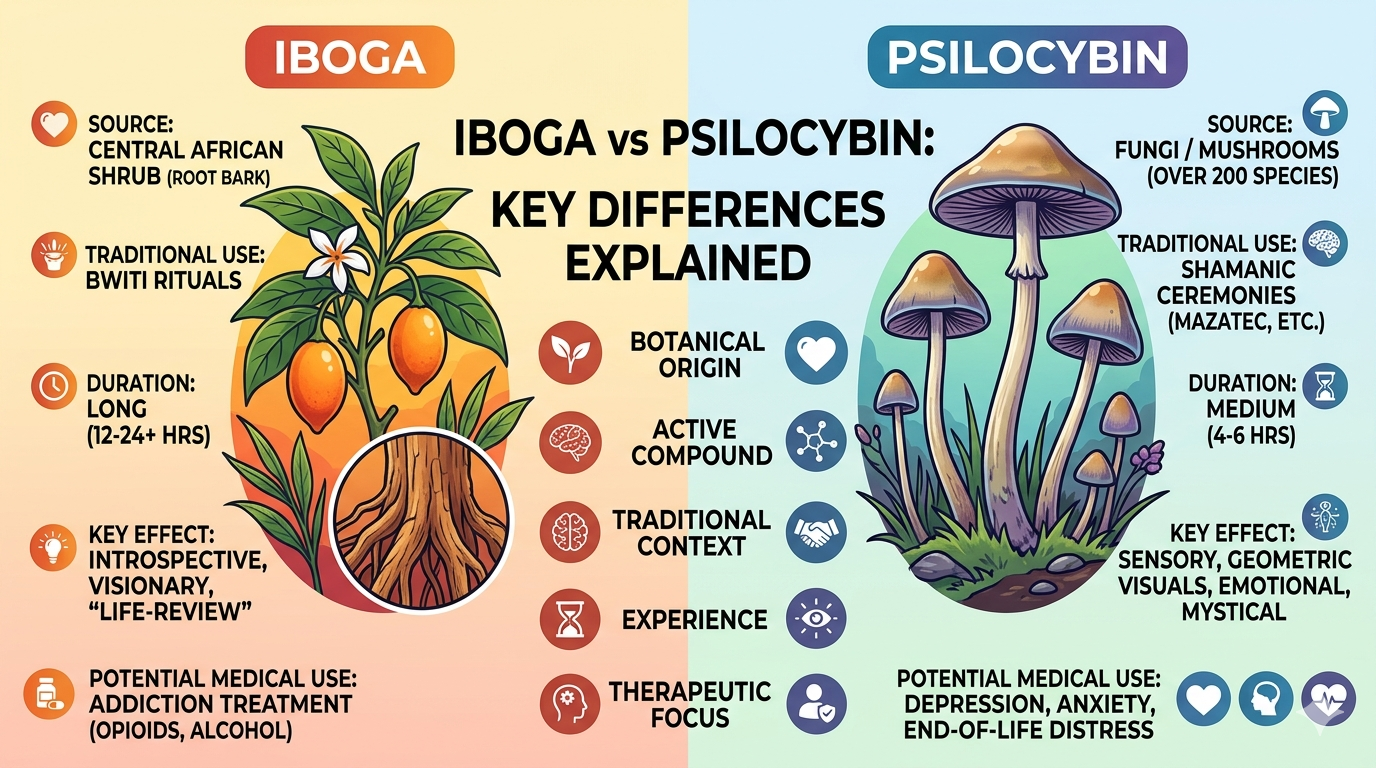
Iboga is the root bark of Tabernanthe iboga, a shrub native to the rainforests of Gabon, where the Bwiti people have used it for thousands of years. Its principal alkaloid is ibogaine, though the whole root bark contains more than a dozen alkaloids that act together. Iboga is taken in traditional ceremony for initiation, healing and self-knowledge. Learn more in our guide to what iboga is.
What Is Psilocybin?
Psilocybin is the psychoactive compound found in more than 200 species of ‘magic mushrooms’ (genus Psilocybe). In the body it converts to psilocin, which acts on serotonin receptors to produce altered perception, emotion and thought. Psilocybin mushrooms have been used by Mesoamerican cultures for centuries and are now among the most-studied psychedelics in modern research, particularly for depression and anxiety. A typical psilocybin experience lasts around four to six hours.
Iboga vs Psilocybin: Side-by-Side Comparison
| Aspect | Iboga / Ibogaine | Psilocybin (Magic Mushrooms) |
|---|---|---|
| Source | Root bark of Tabernanthe iboga (Gabon, Central Africa) | Psilocybe mushrooms (found worldwide) |
| Active compound | Ibogaine plus a dozen-plus alkaloids | Psilocybin (converts to psilocin) |
| Tradition | Bwiti, practised for millennia in Gabon | Mesoamerican and global mushroom cultures |
| Duration | ~12–36 hours | ~4–6 hours |
| Nature of experience | Introspective, dream-like ‘life review’ | Visual, emotional, often mystical or euphoric |
| Best known for | Interrupting addiction; deep transformation | Depression, anxiety, end-of-life distress |
| Physical safety | Carries cardiac (QT) risk — screening essential | Strong physiological safety profile; risks mainly psychological |
| Legal status (US) | Schedule I | Schedule I federally; decriminalised or legal in some states |
Duration: A Few Hours vs a Full Day or More
The most immediate difference is time. A psilocybin journey typically lasts four to six hours. An iboga ceremony is a different order of magnitude: the active experience can last 12 to 36 hours, followed by days of integration. This is one reason iboga is approached as a profound, dedicated rite rather than an afternoon experience.
The Nature of the Experience
Psilocybin is often described as visual, emotional and expansive — a softening of the ego that can bring euphoria, awe and emotional release. Iboga is characteristically different: rather than colourful visuals, many describe a clear-eyed, dream-like ‘life review’ in which memories, patterns and truths are presented with confronting directness. Iboga is frequently experienced as a teacher that shows you what is real, which can feel less blissful and more like work.
How They Work in the Brain
Psilocybin acts primarily as a serotonin 5-HT2A receptor agonist. Iboga and ibogaine act on a broader range of targets — serotonin, the kappa-opioid system, NMDA and nicotinic receptors — and are metabolised into long-lasting noribogaine. Both are linked to neuroplasticity, but iboga’s wider pharmacology is thought to underlie its distinctive effect on addiction. See how ibogaine works for more detail.
Addiction: Iboga’s Distinctive Role
While both substances are being studied for mental health, iboga stands apart for its reported ability to interrupt the cycle of addiction — particularly opioid dependence — often dramatically reducing withdrawal and cravings after a single session. Psilocybin shows great promise for depression, anxiety and addiction too, but it does not produce the same acute withdrawal-interrupting effect that iboga is known for.
Safety: The Most Important Difference
This is where an honest comparison matters most. Psilocybin has a strong physiological safety profile — it is not toxic to the body at normal doses, and its main risks are psychological (a difficult experience in the wrong setting). Iboga is different: ibogaine can affect the heart’s rhythm by prolonging the QT interval, which can be dangerous without proper screening. For this reason, iboga should only be taken after a thorough cardiac evaluation and with medical supervision. Read our iboga safety guide before considering it. Neither medicine should be used casually or alone.
How Does Iboga Compare to Ayahuasca and DMT?
Iboga is often compared with other plant medicines. Ayahuasca (which contains DMT) is a shorter, intensely visionary Amazonian brew, whereas iboga’s journey is longer and more introspective — we cover that in depth in our guide to ayahuasca vs iboga. Pure DMT, by contrast, produces a very short (minutes-long) but extremely intense experience — almost the opposite of iboga’s marathon.
Which Is Right for You?
There is no universally ‘better’ medicine — only what fits your needs, your health and your intention. Psilocybin may suit someone seeking a shorter, gentler opening for depression, anxiety or emotional insight. Iboga may suit someone called to deep, structural transformation or seeking to interrupt addiction, and who can be properly screened and supervised. Whatever the path, set, setting and authentic guidance matter as much as the molecule itself.
Frequently Asked Questions
What is the difference between iboga and psilocybin?
Iboga is the root bark of an African shrub whose alkaloid ibogaine produces a long (12–36 hour), introspective experience associated with interrupting addiction. Psilocybin is the compound in magic mushrooms, producing a shorter (4–6 hour), more visual and emotional journey used mainly for depression and anxiety.
Is iboga stronger than magic mushrooms?
They are hard to compare directly, but iboga is far longer and is widely described as more confronting and physically demanding. It also carries greater physical (cardiac) risk, whereas psilocybin’s main risks are psychological.
Is ibogaine a psychedelic?
Yes. Ibogaine is classed as an oneirogenic (dream-inducing) psychedelic, though its effects differ markedly from classic serotonergic psychedelics such as psilocybin.
Can you combine iboga and psilocybin?
Combining psychedelics is not advised, especially given iboga’s cardiac considerations and the lack of research on such combinations. Each should be approached separately, with proper screening and guidance.
References
- Stanford Medicine (2024). Ibogaine therapy in veterans — Nature Medicine.
- Johns Hopkins Center for Psychedelic & Consciousness Research — psilocybin studies for depression and anxiety.
- Alper, K. R. (2001). Ibogaine: A review. The Alkaloids: Chemistry and Biology.
This article is for educational purposes and is not medical advice. Iboga and psilocybin are powerful, controlled substances; never use them without proper screening, legal awareness and qualified supervision.